Visitors 14
New Year's Eve
December 31, 2025 – The final day of a year that changed everything
December 31, 2025. The pre-dawn darkness is absolute when Johnathan wakes, the world outside still sleeping. He lies perfectly still for a moment, feeling the unfamiliar weight of everything that's changed. The warmth of Liora beside him. The knowledge that two daughters sleep down the hall. The stunning reality that yesterday—just yesterday—he became a married man in a courthouse with no warning, no ring, no traditional ceremony. Just a signature and a promise and a teenage girl who needed them to be brave.
Johnathan's secret thought: I slept with my actual wife last night. My WIFE. That word feels foreign and right at the same time. Three weeks ago I was a solitary coder eating cereal for dinner. Now I'm a husband and father-to-be of two girls, building a family I never knew I desperately needed. The velocity of this terrifies me—but the alternative, living without them, terrifies me more.
He carefully extracts himself from the bed, leaving Liora cocooned in blankets, her red hair spilling across the pillow. The house is cold—the thermostat drops at night to save money—and he shivers as he pads to the kitchen in bare feet and sweatpants.
Coffee. He needs coffee before he can process anything. As the machine gurgles and hisses, he pulls out his tablet, checking email more from habit than expectation. Most people are still on holiday, business dormant until after New Year's.
But there it is—an email from the city's procurement department, time-stamped 6:47 a.m. Someone else is up early, clearing their inbox before the holiday ends. The subject line reads: "RFP: AI-Augmented Citizen Database - Fraud Prevention Initiative."
Johnathan's secret thought: A government contract. AI integration for fraud prevention. This is exactly the kind of Python-based work I've been studying for. The pay would be substantial—government contracts always are. We could use the money. Angel's adoption, legal fees, furnishing her room, increased household expenses. But something about this feels... wrong. Citizen database. Fraud prevention. That's just sanitized language for surveillance, isn't it?
He scrolls through the RFP details. The system would cross-reference welfare applications, unemployment claims, disability benefits, and criminal records—flagging "suspicious patterns" for human review. The pitch is clean: prevent taxpayer fraud, ensure benefits go to legitimate recipients, reduce government waste.
But Johnathan's mind immediately jumps to darker implications. How many false positives? How many people genuinely in need getting flagged by algorithmic bias? He thinks of Angel's mother, imagines her appearing in this database—flagged, investigated, benefits cut off, spiraling deeper into desperation.
Johnathan's secret thought: This is how surveillance states start. Not with jackboots and authoritarianism, but with efficiency and fraud prevention. Every story I've read about China's social credit system, about European data tracking—it always begins with reasonable-sounding initiatives. And here I am, considering bidding on exactly that kind of project because we need the money. What does that make me?
He saves the email to his contracts folder, flags it for later review, but doesn't respond yet. The coffee finishes brewing and he pours a large mug, wrapping both hands around it for warmth.
A memory surfaces—Liora's voice from their early morning conversations: "If the pay is good but the work compromises who you are, what have you really earned?" She'd said that about her own decision to pivot away from pure AI-generated work toward human-augmented design. About maintaining integrity even when easier paths presented themselves.
Johnathan's secret thought: She'd tell me not to bid on it. She'd say we'll find another way to make ends meet. And she'd be right. But the practical part of my brain keeps calculating—mortgage, groceries, utilities, Angel's therapy, legal fees. The money would solve so many immediate problems. Why does doing the right thing have to be so damn expensive?
Movement in the bedroom. He hears Liora stirring, her soft groan as she realizes he's no longer beside her. Moments later she appears in the doorway, wrapped in a robe, her hair magnificently disheveled, squinting against even the dim kitchen light.
Why are you up so early? It's still dark outside. We're supposed to be sleeping in during the last day of vacation.
(gesturing to the coffee pot) My brain doesn't have a vacation setting apparently. Coffee's fresh. Also, I got an interesting email.
She pours herself a cup, adds cream and sugar with the precise measurements she's perfected over days of morning routines, then settles at the table beside him. She's close enough that he can smell her shampoo—something floral and clean.
Interesting good or interesting problematic?
Both, maybe. The city wants to create an AI-augmented citizen database for fraud prevention. It's exactly the kind of Python and AI integration work I've been training for. The contract would be substantial—probably six figures over the year. But...
He turns the tablet toward her so she can read the RFP. Her expression shifts as she scrolls, from curiosity to comprehension to concern.
Citizen database. Cross-referencing benefits with criminal records. Algorithmic flagging of "suspicious patterns." Johnathan, this is surveillance infrastructure dressed up in bureaucratic language.
I know. That's what's been churning in my gut since I opened it. The news is full of stories about government fraud—billions wasted, systems abused. Part of me thinks, well, shouldn't we have better tools to prevent that? But the other part remembers every dystopian warning about surveillance states and algorithmic oppression. China's social credit system started with fraud prevention too.
Liora's secret thought: He's wrestling with this. Really wrestling with it. Not just dismissing the ethical concerns because the money is good. This is why I married him—well, one of many reasons. He has a conscience that won't let him take easy shortcuts. But we DO need the money. Angel's adoption alone could cost thousands in legal fees.
What does your gut tell you? Not your financial anxiety—your actual gut instinct. If money wasn't a factor, would you bid on this?
(long pause, staring into his coffee) No. No, I wouldn't. It feels like building infrastructure that will inevitably be abused. Maybe not immediately, maybe not by the current administration. But once these systems exist, once the surveillance capacity is in place, scope creep is inevitable. What starts as fraud prevention becomes behavior monitoring becomes social control. I've read too much history to think otherwise.
Then don't bid on it. We'll figure out the money some other way. I don't want you compromising who you are just to pad our bank account. Your integrity is worth more than six figures, Johnathan. And honestly? I fell in love with a man who has principles. I'd like to stay married to him.
Her words land with unexpected weight. Johnathan feels something release in his chest—a tension he didn't fully realize he was carrying.
Johnathan's secret thought: She's right. She's absolutely right. If I take contracts that violate my values just because the money is good, what am I building? A career, sure. But at what cost to my soul? And what example does that set for Angel and Mia? That principles are negotiable when the price is right?
You're right. I needed to hear that. I'll decline the RFP. But that means we need to be smart about money. Really smart. I need to land other contracts, ones that don't make my conscience scream. And you need to close that Thompson deal and start building your agency. We're officially a dual-income household now with four mouths to feed.
(smiling, squeezing his hand) We'll make it work. We always do. And hey, we're married now. That means my problems are your problems and vice versa. We face this stuff together.
The word "married" still sends a small jolt through both of them. They exchange glances, then burst into slightly incredulous laughter.
We got married yesterday. In a courthouse. With no warning. And I didn't even get you a ring. What kind of husband am I?
The kind who proposes on one knee in front of a judge to save a teenage girl's life. Honestly? Way more romantic than any ring could be. We'll get rings eventually. Right now we have more important priorities.
A sudden thought strikes Johnathan and he stands abruptly.
Bagels. You mentioned loving breakfast bagels. I'm going to go get us bagels from that place downtown—the good place. Leave you a note so you don't think I got cold feet and ran away after our whirlwind wedding.
(laughing) I just woke up beside you. I think we're past the running-away stage. But yes, bagels sound amazing. Get a variety—we have two growing girls to feed now.
Johnathan scribbles a quick note—"Went for bagels. Not abandoning family. Back soon. —Your husband (still weird to write that)"—and props it against the coffee pot. He bundles into a winter coat, grabs his wallet and keys, and heads out into the predawn cold.
The streets are nearly empty at this hour, holiday silence blanketing everything. He finds parking a few blocks from the bagel shop—the best bagel shop in the city, which unfortunately happens to be in one of the rougher neighborhoods. The gentrification wave hasn't reached this far yet, leaving pockets of visible poverty amid slowly revitalizing blocks.
Johnathan's secret thought: I used to avoid this neighborhood. Too sketchy, too uncomfortable. But now I'm married to a woman who grew up in poverty. Now I'm adopting a girl who lived on these very streets. My privilege doesn't protect me anymore—it just makes me more aware of how much suffering I've been able to ignore.
As he walks toward the bagel shop, he passes a young woman coming the other direction. She's wearing shorts and a thin t-shirt despite the freezing temperature, arms wrapped around herself, shivering violently. She can't be more than sixteen—Angel's age.
Oh my God, girl. You're freezing. Don't you have a jacket?
She stops, turns to look at him with hollow eyes that have seen too much too young. There's a blank quality to her stare—not hostility, just complete emotional flatness. She doesn't respond, just studies him for a long moment, then continues walking.
Johnathan's secret thought: That could have been Angel. Last month, that WAS Angel. Freezing on the street, wearing inadequate clothes, that same thousand-yard stare that comes from trauma and survival mode. How many Angels are still out here?
He enters the bagel shop—warmth and yeast and coffee smells enveloping him immediately. There's a small line at the counter. He's studying the menu board when he hears footsteps behind him and turns to find the same girl who just walked past him outside.
(voice quiet, almost toneless) Can you get me a bagel? I'm starving.
Yeah. Of course. Pick whatever you want.
She steps forward, examining the display case with an intensity that speaks to genuine hunger, not just preference. Then she turns back to him.
Can you get me four? My mom is starving too. We haven't eaten since yesterday morning.
Absolutely. Whatever you need, sweetheart. Pick them out.
The endearment slips out naturally—he's been calling Angel "sweetheart" for days now, the language of fatherhood becoming reflexive. The girl's eyes widen slightly, something flickering across her expression. Confusion? Suspicion? A desperate hope she's trying to suppress?
Lonely Girl's secret thought: He called me sweetheart. Strangers don't do that. Men don't do that unless they want something. But he looks... safe? Maybe? I don't know. I've been wrong before. But I'm so hungry and Mom is so sick and we need food more than I need to be cautious.
(as they wait for their order) Sit with me a minute while they make these. What are you doing out here in the cold? Are you panhandling? I feel panhandled.
He says it gently, with a slight smile, trying to lighten what is clearly a devastating situation. She settles into a chair across from him, pulling her thin arms tighter around herself.
I live on this street. Well, not ON the street exactly. At David Camp, down about three blocks. It's a tent city. Some guy named David started it, so that's what everyone calls it. You new to the area? You don't seem like you know the street.
I'm not new to the city, just... not familiar with this part of it. I come here for the bagels. They're the best in town. David Camp—how long have you been living there?
Three months, maybe? We were in a shelter before that but they have rules—no using, curfews, chores. Mom couldn't handle it. The camp is easier. People don't bother you as much. Everyone's dealing with their own stuff.
Johnathan's secret thought: Three months in a tent. In winter. With a mother who's actively using. This girl is dying slowly and she knows it and there's nothing she can do about it because she's a child with no resources and a parent who can't protect her. Jesus Christ. How does this happen in America?
The conversation continues, the girl gradually relaxing slightly, though never fully letting her guard down. She tells him about life at David Camp—the community dynamics, the constant hustle for food and money, the way people look out for each other in small ways while also being fundamentally self-interested. Survival mode doesn't leave much room for altruism.
She mentions panhandling, the different corners that are more or less productive, which businesses will call the cops and which will just ignore you. She's matter-of-fact about it all, describing horror with the casual tone of someone discussing weather.
(after a pause, studying him carefully) You look nice. Clean. Like you have money. Do you want a girlfriend?
Johnathan's stomach drops. He knows exactly where this is going.
My mom is barely thirty. She's pretty when she's not sick. She's looking for a boyfriend. Someone stable, you know? Someone who could help us out. Or... if you're not into older women... I could be your girlfriend. If you know what I mean.
She's not seductive about it. There's no coy flirtation, no batting of eyelashes. She's making a business proposition, offering services in exchange for resources. It's the most heartbreaking thing Johnathan has ever witnessed.
Johnathan's secret thought: She's soliciting. A child is soliciting me for sex work. And she's so casual about it, so practiced. How many times has she had this conversation? How many men have said yes? I'm going to be sick. I literally feel like I'm going to vomit right here in this bagel shop.
(keeping his voice gentle but firm) I know exactly what you mean. It's called solicitation, and if you get caught, you could end up in jail. Or in your case, probably juvenile detention. I appreciate the offer—and I say that with complete respect for how hard your situation must be—but no. I just got married yesterday. Like, literally yesterday. And I'm finalizing adoption of my teenage daughter. So I'm not interested in dating anyone, you or your mom. I'm sorry.
(bitter laugh) Nobody's putting me in jail. Nobody cares that much. The cops see us and drive right past. We're invisible unless we're causing problems for businesses. Then suddenly everyone cares. But just existing and surviving? Nobody gives a shit about that.
She's not wrong, and they both know it. The silence that follows is heavy with uncomfortable truth.
You said you're adopting a teenage daughter? What's her name?
Angel. Her name is Angel. She's fourteen, turning fifteen in February.
(lighting up slightly for the first time) I knew an Angel! Pretty little thing, latina looking, worked these streets for a while. But I haven't seen her in a few weeks. Figured she either got picked up or found something better. Maybe that was your Angel?
Johnathan's heart clenches painfully. The casualness with which she says "worked these streets"—the matter-of-fact acknowledgment that his Angel, his daughter, was out here doing exactly what this girl just offered to do.
Johnathan's secret thought: Angel was here. On these streets. In this cold. Soliciting strangers. And now she's safe in our house, sleeping in her own bed, with a family who loves her. But this girl is still here. How many girls are still here? And why can't I save them all?
Their order arrives—a bag of bagels, steam rising from the fresh-baked bread. Johnathan pulls out four for the girl, then makes a decision.
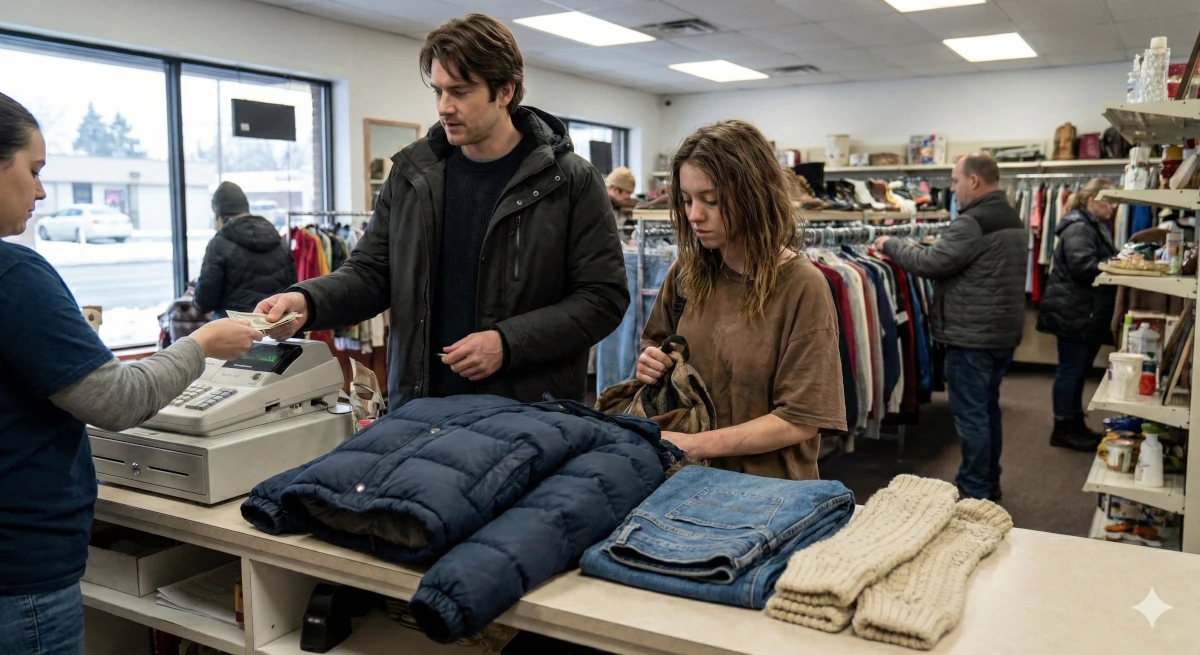
Come with me across the street. There's a thrift store. I'm getting you some warmer clothes. I watched you shivering out there and I can't just walk away knowing you're freezing.
(suspicious) Why? What do you want?
Nothing. I want nothing except for you to not freeze to death. My daughter used to be where you are. Someone helped her. I'm paying it forward. That's all.
They cross the street to the thrift store—already open despite the early hour, catering to the neighborhood's irregular schedules. Johnathan lets the girl choose: jeans, a heavy winter jacket, leg warmers, a scarf, gloves. She keeps looking at him like she's waiting for the catch, the moment when he'll demand payment for his kindness.
At the register, the clerk—a middle-aged woman with tired eyes—leans in close to Johnathan and whispers.
You're wasting your money. She'll sell all this for drug money before the day is out. These items will be back in my store by tonight. I've seen it happen a hundred times.
Johnathan's secret thought: Maybe she's right. Maybe this girl will sell everything I just bought. Maybe her mother will take it and pawn it. Maybe my gesture is completely futile. But what if it's not? What if this jacket keeps her alive one more day? What if that one more day is the day someone offers her a way out? I can't not try.
(to the clerk) Then I guess I'll buy them again when they come back. But today, she has warm clothes. Today matters.
Outside, the girl clutches her bag of clothes and her bagels, looking at Johnathan with an expression he can't quite read—confusion, gratitude, suspicion, all mixed together.
Because you matter. Because my daughter matters. Because all of you matter, even when the world acts like you don't. Take care of yourself, okay? And if you ever want help—real help, not just clothes and food—there are places you can go. Shelters, outreach programs, people who genuinely want to help you.
I've tried shelters. They don't work for people like us. Too many rules, too much judgment. But... thanks. For the clothes. For the food. You're weird, but in a good way, I think.
She walks away, disappearing into the maze of streets. Johnathan stands there for a moment, bagel bag in hand, feeling completely inadequate. One girl helped. Thousands more still out there. The scope of the problem crushes him.
Johnathan's secret thought: Lonely Girl. I don't even know her real name. But I'll remember those lonely eyes for the rest of my life. Where is Lonely Girl's Angel? Where are the people meant to save her? And why does it feel like we're all just one catastrophe away from becoming her?
He drives home slowly, his mind churning. The city wakes around him—traffic increasing, businesses opening, people heading to their New Year's Eve preparations. Normal life for some. Survival for others.
When he arrives home, Liora is standing in the kitchen with his tablet, looking at the screen with a mix of confusion and barely-suppressed accusation.
You know they send email receipts every time you use the credit card, right? Six bagels ordered. Fifty-two dollars spent—between the bagels and something at a thrift store. But you only brought home two bagels. Do you have another family somewhere I don't know about?
She's half-joking, but there's a real edge to her voice. Insecurity creeping in, the newness of their marriage making her vulnerable to doubt.
Liora's secret thought: We've been married one day. ONE DAY. And he's already disappearing for hours and spending money on things he won't account for. Am I being paranoid? Or am I ignoring red flags because I want this to work so badly? My therapist would tell me to ask directly instead of spiraling. So ask, Liora. Just ask.
(setting down the bagels, his expression heavy) No. I met a girl. A teenager, not much older than Angel. She was panhandling on the street in summer clothes, freezing. She asked for food, so I bought her bagels—four for her and her mother. And then I couldn't just walk away knowing she'd freeze, so I took her to the thrift store and got her winter clothes. A jacket, jeans, leg warmers. Basic survival stuff.
Liora's expression shifts immediately from suspicion to understanding, though tears start forming.
Liora, it was so sad. I had to try so hard not to cry right there on the street. She's living in a tent city. She's soliciting—actively offered to be my girlfriend "if I knew what she meant." A child. Offering sex work like she's discussing a retail transaction. And she said she knew a girl named Angel who used to work that street. A pretty little thing, she said, but she hasn't seen her lately.
His voice breaks on the last words. He sits down heavily at the table, running his hands through his hair.
My heart broke into pieces thinking about our Angel out there, just a few weeks ago, doing exactly what this girl is doing. And then I realized—the Angels worked so hard to save her, but there are so many more. Beautiful, precious young girls still out there trying to survive. I didn't even get this girl's name. I just call her Lonely Girl in my mind because her eyes looked so incredibly lonely. Where is Lonely Girl's Angel, Liora? Who's going to save her?
Liora moves to him, wrapping her arms around his shoulders from behind, pressing her cheek against his hair. Her tears fall into his collar.
I know exactly where Lonely Girl's Angel is. I married him.
They sit like that for a long moment, both crying quietly for all the lonely girls in the world, for Angel who escaped, for the thousands who haven't. The weight of knowing too much, of caring too much in a world that seems designed to break hearts.
Liora's secret thought: This is what love looks like. A man who can't walk past suffering without trying to help, even in small ways. A man who sees our daughter in every girl on the street and breaks his heart over all of them. I was so stupid to doubt him, even for a second. This is who I married. This is who I want to be married to.
A sudden noise outside breaks their moment—a large truck parking, backup beeping, voices calling instructions. Liora runs to the window.
Oh my God, they're here already! The moving truck! At my old rental house!
Remember I told you I talked to my landlord about breaking the lease early? He said not to worry about it, that he already had someone who could move in right away. I guess that's them! That was so fast!
That's amazing. Funny how it all works out, right? Like pieces falling into place.
Johnathan's secret thought: Too convenient. Way too convenient. The Angels again, orchestrating circumstances. Linda's church, arranging things behind the scenes. I should probably be more bothered by the manipulation, but honestly? I'm just grateful. Whatever force is guiding this—divine, human, coincidental—it's working in our favor. I'll take it.
The morning progresses into comfortable domesticity. Angel emerges around 10:00 a.m., hair magnificently messy, wearing her new pajamas. Mia follows shortly after, demanding pancakes and orange juice and big-sister cuddles all at once.
Over breakfast, Johnathan and Liora discuss his decision to decline the city contract. Angel listens with surprising attention, asking smart questions about ethics and surveillance and where the line is between security and oppression.
Angel's secret thought: He turned down a huge contract because it felt wrong. Even though we need money. Even though it would solve problems. He chose principles over profit. That's what integrity looks like. That's the kind of person I want to become.
We'll make it work some other way. We always do. Besides, I have faith the Thompson contract will come through, and that's substantial. Plus once I get the agency fully operational, we'll have more stable income.
And I can help! I've been practicing design work every day. I'm getting faster. Maybe by summer I can take on real client work, even small projects. I want to contribute, not just cost money.
Sweetheart, you're our daughter, not an employee. Yes, learning skills is important and we love that you're passionate about design. But you don't have to earn your place here. You belong here just by existing. Got it?
Angel's secret thought: I don't have to earn my place. I belong just by existing. That's such a foreign concept. I've spent my whole life trying to earn the right to take up space. Trying to be useful enough that people will tolerate me. Maybe I can learn to just... be. Without performing or producing or proving anything.
Afternoon brings activity—errands and preparations for a quiet New Year's Eve at home. They grocery shop together, the four of them navigating crowded aisles with the practiced coordination of a team. Angel suggests ingredients for homemade pizza. Mia insists on ice cream and cookies for dessert. Johnathan vetoes energy drinks but allows sparkling cider for midnight toasts.
Around 2:00 p.m., Liora hears giggling from the back yard. Curious, she looks out to see Angel at the fence, talking animatedly to a girl on the other side—blonde hair, slightly taller than Angel, gesturing excitedly with her hands.
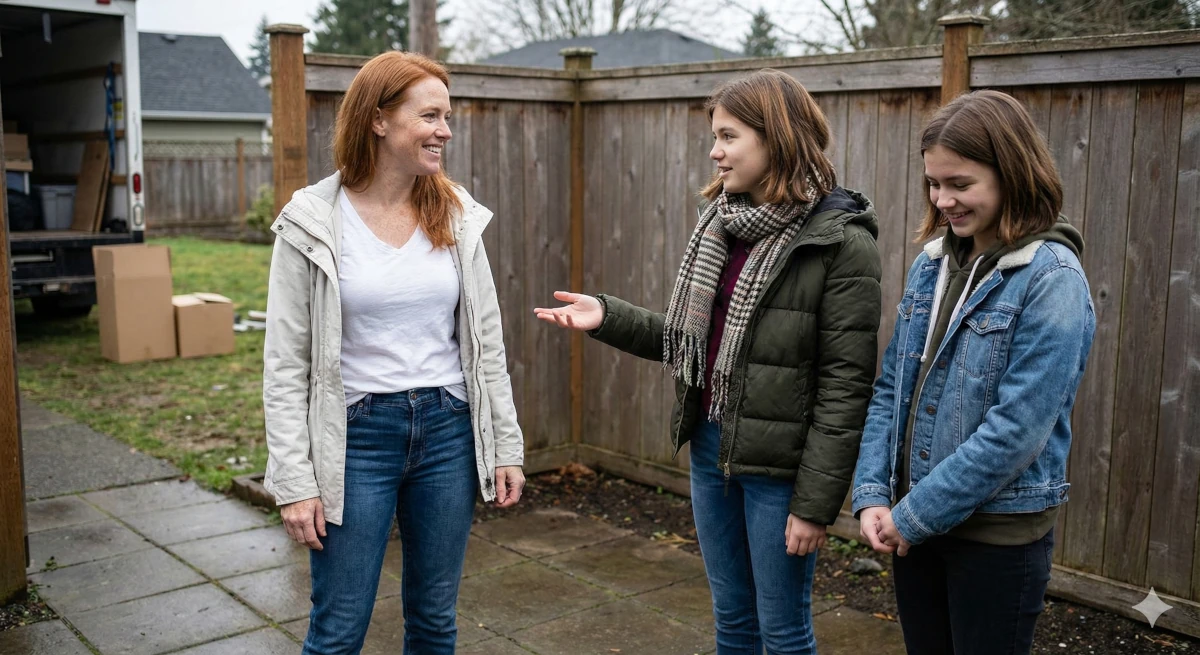
Moments later, Angel bursts through the back door, practically vibrating with excitement.
Mom! MOM! That's Jennifer, the girl moving in next door! She's almost sixteen—February birthday, just like me but a year apart! Can she come over? Can she spend the night? Please? We're going to be best friends, I can already tell!
Liora's secret thought: She called me Mom. Not Liora, not "my soon-to-be-mom." Just Mom. Casual, automatic, like I've always been Mom. My heart is exploding right now.
Slow down, honey. I don't even know Jennifer yet. Does she have her parents' permission to come over? And definitely permission to spend the night?
(whispering urgently) Mom. You're embarrassing me. Jennifer is almost sixteen. She's practically an adult. You don't need to talk to her mother.
Actually, honey, this is one of those boundary things we've been talking about. I need to know who's in our house, especially overnight guests. And yes, I absolutely need to talk to her mother. Not to embarrass you—just to introduce myself and make sure everyone's comfortable with the arrangement. Is she moving in next door?
(rolling her eyes dramatically) Yes, fine. She's moving in next door with her mom. Her parents are divorced. Go introduce yourself. But can you please not be weird about it?
Angel's secret thought: This is so embarrassing. Normal teenager embarrassing, not trauma embarrassing. I'm embarrassed because my mom wants to meet my friend's mom. That's such a wonderfully mundane problem to have. I love it.
Liora heads next door, noting the moving truck and the organized chaos of boxes and furniture. She knocks on the partially-open door, calling out a greeting.
A woman appears—early thirties, dark hair pulled back in a messy ponytail, wearing jeans and a sweatshirt dusted with moving debris. She's attractive in an understated way, with intelligent eyes and an exhausted but friendly smile.
Hi! You must be from next door. I'm Mildred—yes, I know, my parents named me after my great-grandmother and I'm stuck with it. Come in, but watch your step. We're in full chaos mode.
I'm Liora. My husband and I live next door with our two daughters. Actually, your daughter Jennifer and my daughter Angel have already met over the fence and apparently decided they're best friends. Angel wants Jennifer to come over and spend the night for New Year's Eve.
(laughing) That was fast. Jennifer was just telling me about this amazing girl next door. How old is Angel?
She'll be fifteen in February. We just finalized her adoption—well, started the legal process. It's complicated. But she's definitely ours now. Forever.
Jennifer turns sixteen in February. And yes, absolutely, she can spend the night. Actually, that's perfect timing—I have so much unpacking to do and Jennifer would just be bored and complaining. If she's next door making friends, that's ideal. Just send her back tomorrow to help with the rest of this mess.
They talk for another twenty minutes—the easy conversation of two single mothers who've fought similar battles, who understand divorce and resilience and starting over. Mildred works as a freelance interior decorator, increasingly using AI to generate initial design concepts before refining them with human expertise.
Liora's secret thought: She's doing exactly what I'm doing—using AI as a tool, not competing with it. We're in parallel industries facing parallel challenges. This could be the beginning of a real friendship. Adult friendship. I haven't had that in so long.
They discuss the AI revolution, share strategies for staying relevant, commiserate about client expectations and pricing pressure. The conversation flows naturally—professional camaraderie mixing with personal connection.
We should collaborate sometime. I do space design, you do branding and graphics. Between us, we could offer comprehensive creative services. The AI augmented by human expertise model—that's the future.
I was literally just thinking the same thing. Let's talk after New Year's, once you're settled. I'm building an agency—this could be exactly the kind of partnership that makes sense.
Liora returns home to find Angel and Jennifer already in Angel's room, music playing, laughter spilling out. She pauses outside the door, listening to teenage girl conversation—rapid-fire, jumping between topics, punctuated with giggles and dramatic declarations.
Liora's secret thought: Normal. She sounds so beautifully normal. Not traumatized, not guarded, not performing. Just a teenage girl laughing with a friend. This is what healing looks like. This is what safety creates space for.
Evening settles in. Johnathan and Angel work together in the kitchen preparig to make homemade pizzas. Mia "supervises," offering unsolicited advice and stealing pepperoni when she thinks no one is watching.
Just as they're about to start making the pizzas, Angel grins mischievously and pulls out Johnathan's credit card.
Actually, change of plans. I already ordered pizza and wings and breadsticks from that place downtown. It'll be here in twenty minutes. Surprise!
(mock-stern) Did you steal my credit card information, young lady?
You left it on the counter. I saved the number. I wanted to do something nice—you and Mom have been doing everything. Let me contribute, even if it's just ordering dinner.
Johnathan's secret thought: She wanted to contribute. To give something back. That's her healing too—learning she can provide, can care for others, can be part of the family's functioning instead of just receiving. I should probably talk to her about taking credit cards without asking, but right now I'm just proud of her.
They eat around the table—six of them now with Jennifer added to the family unit. Conversation flows easily: school plans, design work, Jennifer's stories about her previous neighborhood, Mia's increasingly elaborate tales about her stuffed animals' adventures.
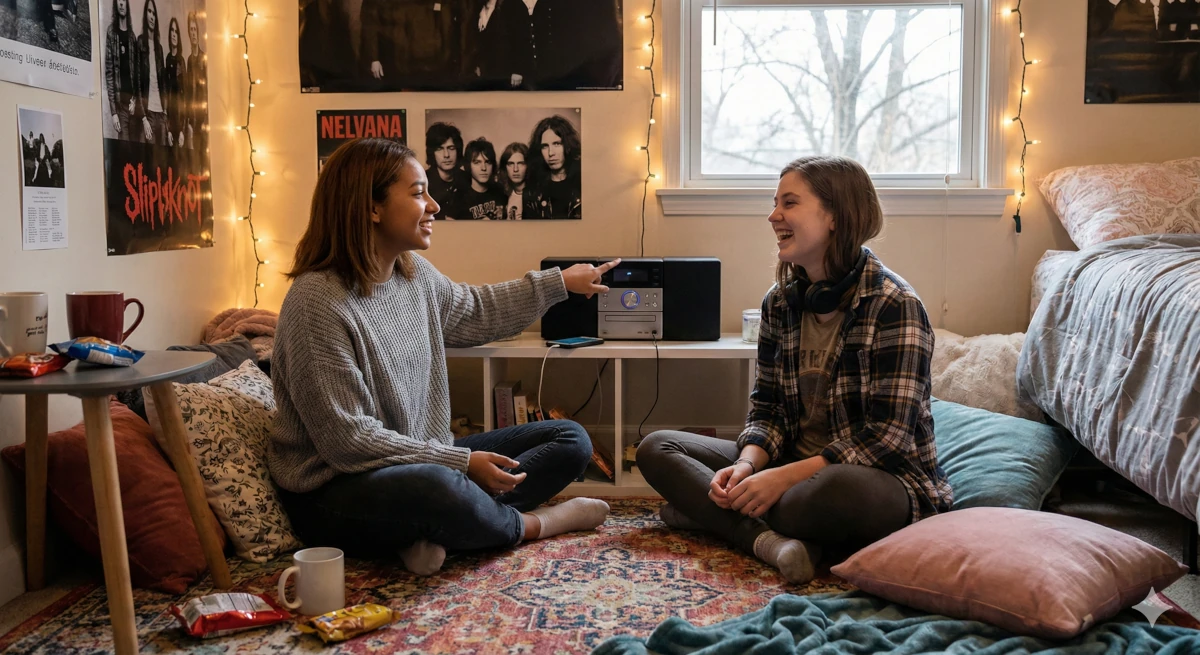
After dinner, the girls disappear upstairs to Angel's room. Music pulses through the floor—not too loud, just the soundtrack of teenage life. Liora and Johnathan clean the kitchen together, working in comfortable silence occasionally broken by observations about their suddenly expanded household.
Angel has a friend. A real friend. Someone her own age who lives next door. That's huge.
And you have a potential business partner and friend. Funny how that worked out—Mildred moving in right when we need exactly what she offers.
The Angels again. It's always the Angels. I don't even know how much of our life is coincidence versus orchestration anymore. Linda's church is way more involved in our lives than I'm entirely comfortable with.
But they keep bringing good things. Angel. Judge Janet. Now Mildred and Jennifer. Maybe we should just be grateful instead of questioning it.
I am grateful. I'm just also... aware. That we're part of something bigger than we fully understand. That we're being guided toward something. I don't know what yet.
As midnight approaches, they gather in the living room—all six of them squeezed onto the couch and floor, sparkling cider poured into mismatched glasses, the TV showing the New York City countdown.
Ten seconds. Nine. Eight. The girls giggle, already hyped on sugar and excitement. Seven. Six. Five. Johnathan reaches for Liora's hand. Four. Three. Two. One.
"HAPPY NEW YEAR!"
They toast with cider, kiss their respective people, hug in a chaotic group embrace. Outside, fireworks explode in distant neighborhoods. Inside, a family celebrates the beginning of everything.
Liora's secret thought: Two thousand twenty-six. A new year. A new family. A new life. Everything ahead is uncertain—Angel's adoption, our careers, all the challenges we haven't even imagined yet. But we're together. We're committed. We're ready. Bring it on, 2026. We're not afraid.
Johnathan's secret thought: Three weeks ago I was alone. Now I'm surrounded by love—a wife, two daughters, a friend for Angel, a neighbor who might become family too. Everything changed so fast I'm still catching up mentally. But this is what the Angels planned. This is what we were guided toward. And it's more beautiful than anything I could have imagined.
Angel's secret thought: Last New Year's Eve I was in a trap house, high and scared and convinced I'd be dead before fifteen. This year I'm sober, safe, surrounded by people who love me, with a best friend giggling beside me and parents who chose me. A year ago I was dying. Tonight I'm alive. Really, truly alive. Thank you, Angels. Thank you for saving me.
Mia's secret thought: I love my family. I love my big sister. I love that Jennifer is here making Angel happy. I love that Mommy and Johnathan are married. I love everything about right now. This is the best New Year ever and I'm never going to forget it.
The celebration winds down gradually. Jennifer and Angel retreat upstairs, their laughter and music continuing late into the night—the sounds of friendship and healing and normal teenage life. Mia falls asleep on the couch, curled up with her stuffed bunny. Johnathan carries her to bed, tucking her in with practiced gentleness.
Liora and Johnathan finally collapse into their own bed around 1:00 a.m., exhausted and happy and slightly overwhelmed by everything that's happened in just three weeks.
We're married. We have two daughters. We have neighbors who might become close friends. We survived Christmas and Angel's court appearance and a surprise wedding. And now it's 2026. What do we do now?
We wake up tomorrow and keep building this life. One day at a time. One challenge at a time. Together.
Together. I like the sound of that.
They fall asleep tangled together, the house quiet except for soft music still playing in Angel's room and the occasional distant pop of fireworks. Outside, the first hours of 2026 unfold—cold and dark and full of infinite possibility.
Somewhere across town, Lonely Girl huddles in her new jacket, bagels eaten hours ago, wondering about the strange man who helped her without asking for anything in return. She doesn't believe in Angels—life has taught her better than that. But maybe, just maybe, there's more to the world than survival and exploitation. Maybe somewhere, somehow, there's hope.
Maybe her Angel is out there too, just waiting for the right moment to appear.
The world splits in two—those trapped in old patterns of suffering, and those breaking free into new possibilities. The line between the two is thin, permeable, crossable. Angel crossed it. Lonely Girl could too.
But tonight, in a house on a quiet suburban street, a family sleeps—grateful, exhausted, hopeful, and deeply, profoundly blessed. Whatever challenges 2026 brings, they'll face them together. Forever and for real.