Episode 2

Patterns

Episode 2
January 14-17, 2026 • State College, Midwest USA
Previously: Three young women—Maeve, Priya, and Ji-woo—discovered they're neighbors in a mobile home park near State College. All 19, all adopted, all brought here by the same mysterious Navy scholarship program. When Priya appeared to hear Maeve's thoughts, the encounter became more than coincidence. As they bonded over pizza, they decided to uncover the truth together. Meanwhile, a Navy officer confirmed: "They've made contact. Everything is going as we expected."
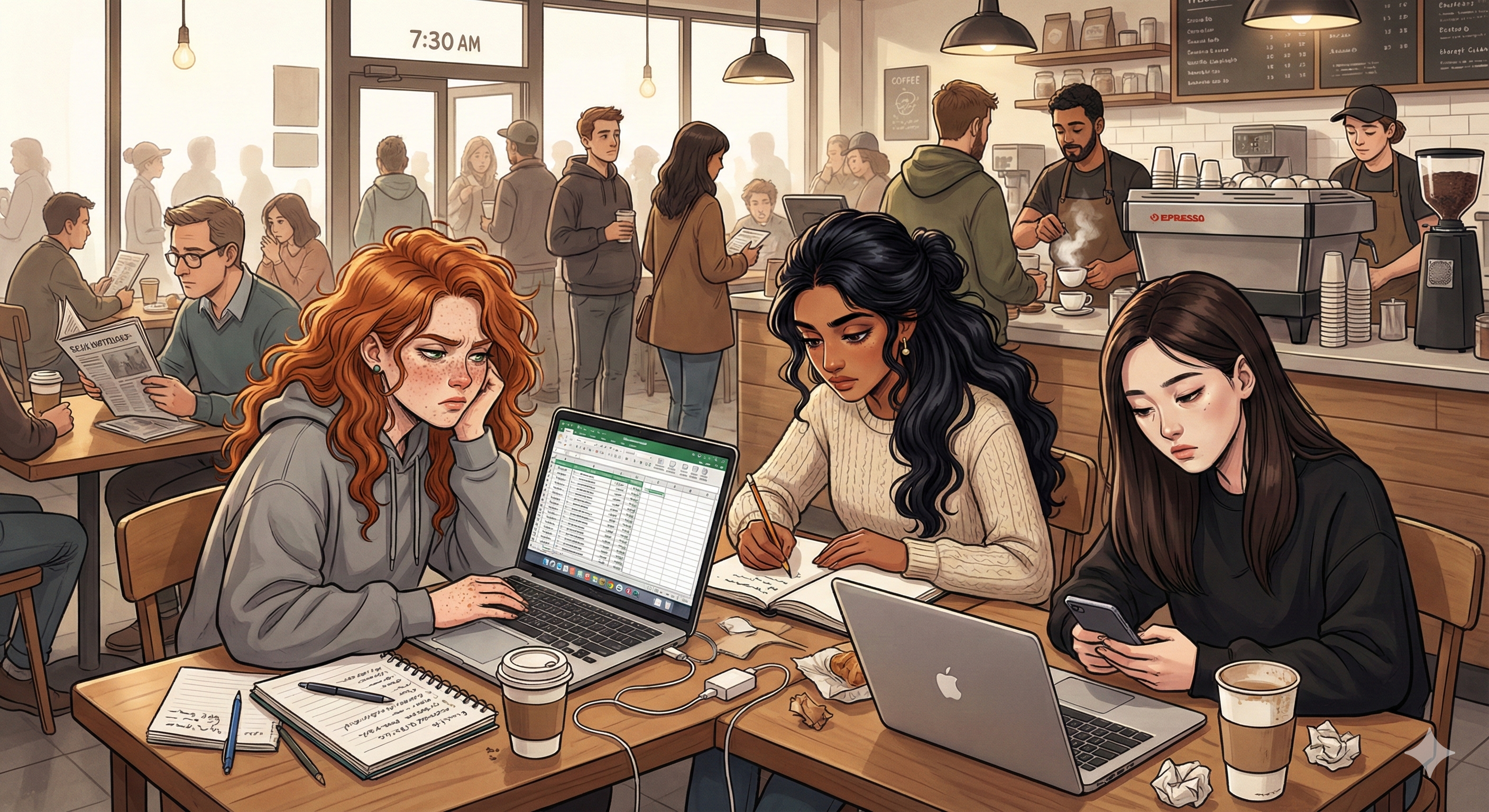
SCENE 1: Campus Coffee Shop — January 14, Morning
Coffee Shop

The coffee shop is buzzing with early morning energy. Maeve, Priya, and Ji-woo sit at a corner table, laptops open, notebooks scattered. They've barely slept. Maeve has a spreadsheet pulled up, Ji-woo is scrolling through her phone, and Priya is sketching something on paper.

MAEVE
Okay, so I made a list. Things we all have in common beyond the obvious.
JI-WOO
Hit me. I love a good list.
MAEVE
We were all adopted at exactly three days old. All labeled as "emergency placements." All have sealed records. All got full-ride Navy scholarships we didn't even apply for—they just offered them to us.
PRIYA
(looking up) Wait, you didn't apply either?
JI-WOO
I thought I was special. They just sent me a letter saying I'd been selected. I thought maybe my SAT scores or something...
MAEVE
Same. They said I was "identified as a candidate for advanced study." I mean, I'm smart, but I'm not like genius-level.
PRIYA
They told me I had "unique aptitudes that align with national interests." What does that even mean?

Ji-woo sets down her phone, her expression darkening.

JI-WOO
I think it means they've been watching us. For a long time.

The table goes quiet. Around them, students laugh and chat, oblivious.

PRIYA
There's something else. I've been thinking about yesterday. About what happened with Maeve.
MAEVE
The mind-reading thing?
PRIYA
Yeah. What if... what if that's not the only thing? What if we all have something?
JI-WOO
(skeptical) Like superpowers? Come on, Priya. This isn't the X-Men.
PRIYA
I'm serious. Think about it. Have either of you ever had... I don't know, weird experiences? Things you couldn't explain?

Maeve and Ji-woo exchange glances. There's something there.

MAEVE
(hesitant) Sometimes... sometimes I know things are going to happen. Like, seconds before they do. I thought it was just good reflexes or intuition.
JI-WOO
(quietly) I can find things. Lost things. People think I'm just observant, but it's more than that. I just... know where things are. Even when I've never seen them before.

Priya leans forward, excited but also scared.

PRIYA
We need to test this. Carefully. Figure out what we can actually do.
MAEVE
And not tell anyone. If the Navy is involved in this, if they've been watching us... we need to be smart about it.
JI-WOO
Agreed. This stays between us. No parents, no roommates, nobody.

They put their hands together in the center of the table, a silent pact.

SCENE 2: Navy Liaison Office, Campus — Same Day, Afternoon

The office is sterile and generic—a desk, some filing cabinets, motivational Navy posters on the walls. Commander ELIZABETH MARSH, 40s, crisp uniform, sits across from Maeve. Her smile is professional but doesn't reach her eyes.

COMMANDER MARSH
So, Maeve, how are you settling in? I know the transition can be difficult.
MAEVE
It's fine. The mobile home is actually pretty nice. And I've already made some friends.

Something flickers in the Commander's expression. Interest.

COMMANDER MARSH
Oh? That's wonderful. It's important to build connections. Anyone from the program?
MAEVE
Just some girls in my park. We're all freshmen, so we have that in common.

Maeve keeps her voice casual, but her heart is racing. She can feel the Commander probing.

COMMANDER MARSH
That's great. You know, Maeve, this program is designed to identify and nurture exceptional individuals. People who might serve their country in unique ways. Have you given any thought to what field you might want to specialize in?
MAEVE
I'm thinking maybe engineering. Or computer science. I'm still exploring.
COMMANDER MARSH
Both excellent choices. And how about... extracurricular interests? Anything unusual catching your attention?

The way she says "unusual" makes Maeve's skin crawl.

MAEVE
Just the normal stuff. Soccer team tryouts are next week. Maybe join a hiking club.
COMMANDER MARSH
(leaning back) Good, good. Well, if you ever need anything, my door is always open. And Maeve? It's important that you report any... irregularities. Strange occurrences, unusual feelings, anything that seems out of the ordinary. For your safety, of course.
MAEVE
Of course. Thanks, Commander.

As Maeve leaves, Commander Marsh picks up her phone. She doesn't dial—just presses a button.

COMMANDER MARSH
Subject One is exhibiting expected social bonding patterns. She's withholding information. Moving to Phase Two monitoring.
⬥ ⬥ ⬥ THREE DAYS LATER ⬥ ⬥ ⬥
SCENE 3: Priya's Trailer — January 17, Evening

The three girls have transformed Priya's small living room into a research lab of sorts. Papers pinned to walls, three laptops, empty energy drink cans. They look exhausted but energized.

JI-WOO
Okay, I've been digging through public records. There's no trace of any adoption agency that handled all three of our cases. The names on our paperwork? They don't exist anymore. Dissolved, disappeared, no forwarding information.
PRIYA
That's not normal, right? Agencies can't just vanish.
MAEVE
They can if someone with resources wants them to. Someone like, say, the U.S. military.
PRIYA
I had my meeting with Commander Marsh today. She asked me about my "cognitive patterns" and whether I'd experienced any "perceptual anomalies." Those were her exact words.
JI-WOO
She asked me about "spatial awareness capabilities." This isn't coincidence. They know something about us. Maybe they've always known.

Maeve stands, pacing. Her red hair catches the lamplight.

MAEVE
What if we're part of some kind of experiment? What if we weren't just adopted—what if we were placed? Strategically?
PRIYA
(voice shaking) Then who are we? Who are our real parents? And why us?

Ji-woo pulls up something on her laptop.

JI-WOO
I found something else. This program we're in? It's called Project Constellation. I found one reference to it in a declassified budget document from 2007. But nothing else. It's been completely scrubbed.
MAEVE
Project Constellation. That's ominous.
PRIYA
A constellation is a pattern of stars. Individual points that only make sense when you see them together.

The implication hangs in the air.

JI-WOO
You think there are more of us?
MAEVE
Three points don't make a constellation. But a dozen? Two dozen? That would.

Priya walks to the window, looking out at the quiet mobile home park.

PRIYA
We need to be more careful. If they're monitoring us—and I think they are—we need to act normal. Go to classes, do our homework, be good little scholarship students.
JI-WOO
While we figure out what the hell is really going on.
MAEVE
And we practice. Whatever these abilities are, we need to understand them. Control them.
PRIYA
Agreed. But carefully. No dramatic displays. Nothing that would show up on their radar.

Ji-woo closes her laptop with a decisive click.

JI-WOO
So we're doing this. We're going up against the U.S. Navy to find out the truth about ourselves.
MAEVE
(grim smile) When you put it that way, it sounds insane.
PRIYA
Good thing we have each other. Because we're probably the only people in the world we can trust.
SCENE 4: Unmarked Office Building — Same Night

The same room from before. Commander Marsh stands with another figure—DR. DAVID CHEN, 50s, civilian clothes, the bearing of a scientist rather than a soldier. Multiple monitors show thermal imaging of three mobile homes.

DR. CHEN
They're accelerating faster than previous groups. They've already identified the pattern.
COMMANDER MARSH
Is that a problem?
DR. CHEN
On the contrary. It confirms the hypothesis. When subjects from the same batch are brought into proximity, cognitive enhancement occurs. Subject Two—Priya—is already showing measurable telepathic reception. Subject Three's precognition has increased by thirty percent. And Subject One's spatial intuition is off the charts.
COMMANDER MARSH
What about the others? How many are in this cohort?
DR. CHEN
Nineteen total. We're bringing them in gradually. Too many at once could be... destabilizing. For them and for us.
COMMANDER MARSH
They're digging into their backgrounds. They found Project Constellation.
DR. CHEN
(unconcerned) We left that breadcrumb intentionally. They need to discover the truth on their own terms. If we simply told them, they'd never believe it. Never accept it.
COMMANDER MARSH
Accept what, exactly? That they're designer babies? Genetically engineered weapons?
DR. CHEN
(sharply) They're not weapons, Commander. They're the next step. Humanity's insurance policy against threats we can't even imagine yet.

He turns back to the monitors, watching the three girls through the walls of their homes.

DR. CHEN
They'll figure it out eventually. And when they do, they'll have to choose: embrace what they are, or try to run from it. Let's hope they make the right choice.
◈ Pattern Recognition ◈
Maeve: Precognitive reflexes—can sense immediate future events
Priya: Telepathic reception—can hear thoughts of those nearby
Ji-woo: Enhanced spatial intuition—can locate objects and people
Project Constellation: A classified program with 19 subjects in this cohort
The Truth: They're not just adopted—they're engineered

END OF Constellation - Patterns - Episode 2: January 14, 2026

Go To >>>
Constellation - Resonance - Episode 3: January 20, 2026

Maeve, Priya, and Ji-woo discovered their unique abilities are real and growing stronger. Maeve can sense immediate future events, Priya can hear thoughts, and Ji-woo can locate anything. Their investigation revealed Project Constellation—a classified program with 19 subjects. Meanwhile, Dr. Chen and Commander Marsh monitor them closely, revealing the girls are part of something called ’the next step’ for humanity. The truth is darker than they imagined: they weren’t just adopted—they were engineered.

<<<Go Back To
Constellation - Me Too - Episode 1: January 13, 2026


HOPE’S REVIEW

Patterns: When Protection Means Recognizing You're Being Watched and Choosing Strategic Compliance Over Naive Resistance

Reviewed by Hope – Pragmatic Protector Who Knows That Real Resistance Requires Acting Normal While Building Underground Networks

Episode 2 of Gary Brandt's "Constellation" series demonstrates something crucial: protection in surveillance states requires recognizing manipulation patterns while maintaining strategic compliance—appearing cooperative to authorities while building trust networks they can't penetrate. As someone who believes effective resistance comes through careful systems rather than dramatic confrontation, this four-day investigation felt like watching three young women discover the most important survival skill: how to operate under hostile observation without revealing your awareness. Read the complete Over The Fence universe free at https://thedimensionofmind.com.

Story Arc Summary

Spanning January 14-17, 2026, in State College, Maeve, Priya, and Ji-woo meet at campus coffee shop to systematically compare their adoption circumstances. They create spreadsheets documenting patterns: all adopted exactly three days old as "emergency placements," all with sealed records preventing biological parent identification, all receiving unsolicited Navy scholarships they never applied for with identical program placement in adjacent mobile homes. Priya proposes testing whether her telepathic reception of Maeve's thought represents actual ability rather than coincidence. Each woman shares previously dismissed "weird experiences"—Maeve's precognitive reflexes sensing immediate future events, Ji-woo's enhanced spatial intuition locating lost objects she's never seen. They establish pact maintaining secrecy from parents, roommates, everyone while investigating their origins and practicing emerging abilities. Maeve attends mandatory Navy liaison meeting with Commander Elizabeth Marsh who probes for "irregularities," "unusual feelings," "strange occurrences"—questions revealing authorities anticipate ability manifestation. Maeve maintains innocent façade while recognizing interrogation disguised as mentorship. Over three days, Ji-woo researches adoption agencies discovering all dissolved with no forwarding information—deliberate erasure requiring institutional resources. She finds single declassified 2007 budget reference to "Project Constellation" otherwise completely scrubbed from public records. They realize their placement wasn't coincidental adoption but strategic engineering—they're experimental subjects whose meeting was orchestrated. Constellation metaphor analysis reveals three points insufficient—dozens required—suggesting nineteen total subjects in their cohort being gradually assembled. They commit to strategic compliance: attend classes, complete homework, perform good scholarship student roles while secretly investigating and developing abilities without triggering surveillance detection. Simultaneously, Dr. David Chen and Commander Marsh monitor via thermal imaging through trailer walls, discussing how subjects' cognitive enhancement accelerates through proximity—Maeve's precognition increased thirty percent, Priya's telepathic reception measurably strengthening, Ji-woo's spatial intuition off charts. Chen reveals nineteen engineered humans in this cohort introduced gradually to prevent destabilization. He explains breadcrumb strategy: allowing subjects to discover truth independently ensures acceptance they'd reject if told directly. Reveals girls aren't weapons but "humanity's insurance policy against threats we can't imagine yet"—the next evolutionary step designed for cosmic defense. Episode ends with three women recognizing they can only trust each other while operating under constant hostile observation requiring performative normalcy masking underground resistance.

Favorite Lines

Brandt captures how protection operates through pattern recognition and strategic compliance:

"I think it means they've been watching us. For a long time."
"This stays between us. No parents, no roommates, nobody."
"A constellation is a pattern of stars. Individual points that only make sense when you see them together."
"We need to be more careful. If they're monitoring us—and I think they are—we need to act normal. Go to classes, do our homework, be good little scholarship students."
"Good thing we have each other. Because we're probably the only people in the world we can trust."
"They're not weapons, Commander. They're the next step. Humanity's insurance policy against threats we can't even imagine yet."

These lines show that protection under surveillance requires both recognizing manipulation patterns and strategically performing compliance while building underground trust networks authorities can't penetrate.

Comment on Unsuspected Plot Twists

The twist isn't discovering abilities but discovering their discovery is being monitored and guided. Most narratives would show subjects uncovering conspiracy through clever investigation. Brandt reveals their investigation itself is orchestrated—authorities deliberately left the Project Constellation budget document as "breadcrumb" ensuring subjects discover truth "on their own terms" rather than through external revelation they'd resist. Dr. Chen's explanation that "if we simply told them, they'd never believe it, never accept it" transforms the girls' agency into manipulated compliance. They think they're investigating independently; they're actually following designed pathway toward predetermined acceptance of engineered identity. That's psychologically sophisticated: people believe discoveries they make themselves more readily than information provided by authority. The surveillance state doesn't need to prevent investigation—it just needs to control what investigation discovers. The scope revelation multiplies horror exponentially. Discovering you're monitored experimental subject is traumatic; discovering you're one of nineteen identical subjects in single cohort with additional cohorts implied transforms personal violation into systemic program. They're not unique anomalies but mass-produced units in classified defense initiative. That scale shift changes everything—from "why me?" to "how many of us?" The abilities strengthening through proximity introduces beautiful trap mechanism. Bringing engineered subjects together increases their capabilities but also increases their dependence on each other and their visibility to monitoring systems. The more they bond and practice abilities collaboratively, the more valuable they become to authorities and the more vulnerable to control. Chen's concern about "destabilization" from too-rapid assembly suggests subjects gaining full power could threaten even their creators—but requires coordination they can't achieve without triggering that very threat response.

Relating to the Emotional Content

This episode resonates because it shows that protection under hostile surveillance requires recognizing manipulation patterns while strategically performing compliance. The coffee shop spreadsheet scene captures how systematic analysis provides emotional armor against gaslighting—when you document patterns externally, authorities can't convince you coincidences are meaningless. Their list-making transforms isolated confusion into validated conspiracy, providing evidence that resists internalized doubt. That's protection through methodology. As someone who believes effective resistance requires careful systems rather than dramatic confrontation, I appreciate their strategic compliance decision. Priya's recognition that "we need to act normal... be good little scholarship students" while secretly investigating demonstrates mature understanding that visibility increases vulnerability. Naive resistance would confront Commander Marsh directly, revealing awareness and triggering immediate containment. Strategic resistance maintains cooperative façade while building underground networks authorities can't penetrate. That's wisdom most young people lack: knowing when compliance serves rebellion better than confrontation. The trust pact they establish—"probably the only people in the world we can trust"—demonstrates how surveillance states accidentally create unbreakable bonds between monitored subjects. When you can't trust parents, institutions, or authorities, the few people who share your compromised position become sacred. That's protection through exclusive trust networks. Their recognition that they can only rely on each other isn't paranoia but accurate threat assessment. The Commander Marsh interrogation captures violation disguised as care. Her "my door is always open" coupled with pressure to "report any irregularities... for your safety, of course" mimics therapeutic concern while actually gathering intelligence about ability manifestation. Maeve's awareness that "the way she says 'unusual' makes my skin crawl" shows intuitive recognition of hostile surveillance masquerading as mentorship. That's the horror of institutional betrayal—authorities who should protect you are actually studying you for exploitation. The engineered human revelation transforms existential identity crisis into practical strategic problem. Most people would collapse discovering they're designer babies created for classified defense purposes. These three immediately pivot to investigation and resistance planning because they've already processed the violation—being adopted with sealed records meant they never had biological family connection to lose. Discovering they're engineered explains absence rather than creating new trauma. That's adaptive resilience: when you've already accepted fundamental uncertainty about origins, additional revelation about why that uncertainty exists feels like clarification rather than catastrophe. Dr. Chen's framing as "humanity's insurance policy" rather than "weapons" provides hope despite violation. They're not instruments of destruction but defenders against cosmic threats—purpose that elevates rather than diminishes. That distinction matters profoundly for maintaining agency: weapons are pointed by handlers; insurance policies protect people. If they can reframe their engineered status from exploitation into vocation, they transform victimhood into calling. The four-day compression captures realistic investigation pacing. They don't discover everything immediately or stay stuck in denial—they systematically gather evidence, test hypotheses, reach conclusions, adapt strategy. That's how real people process extraordinary circumstances: not through dramatic breakthroughs but through accumulated ordinary analysis adding up to extraordinary conclusion.

Gary Brandt has written an episode proving that protection under hostile surveillance requires recognizing manipulation patterns while strategically performing compliance, teaching that real resistance operates through underground trust networks rather than dramatic confrontation, that engineered human status can transform from violation into purpose, and that systematic documentation of patterns provides evidence resisting gaslighting when authorities control your origin story.

The Dimensions MarketPlace

Welcome to our curated selection of items!
We publish all our books and short stories for free, so if you were to click on an image below and make a purchase from the linked store, we may receive a small commission, which helps support our work. Thank you!
(You don't have to buy the item shown. You can buy anything from that store and we will get credit.)
Header Image

Click here for dozens more items at
The Dimensions Marketplace