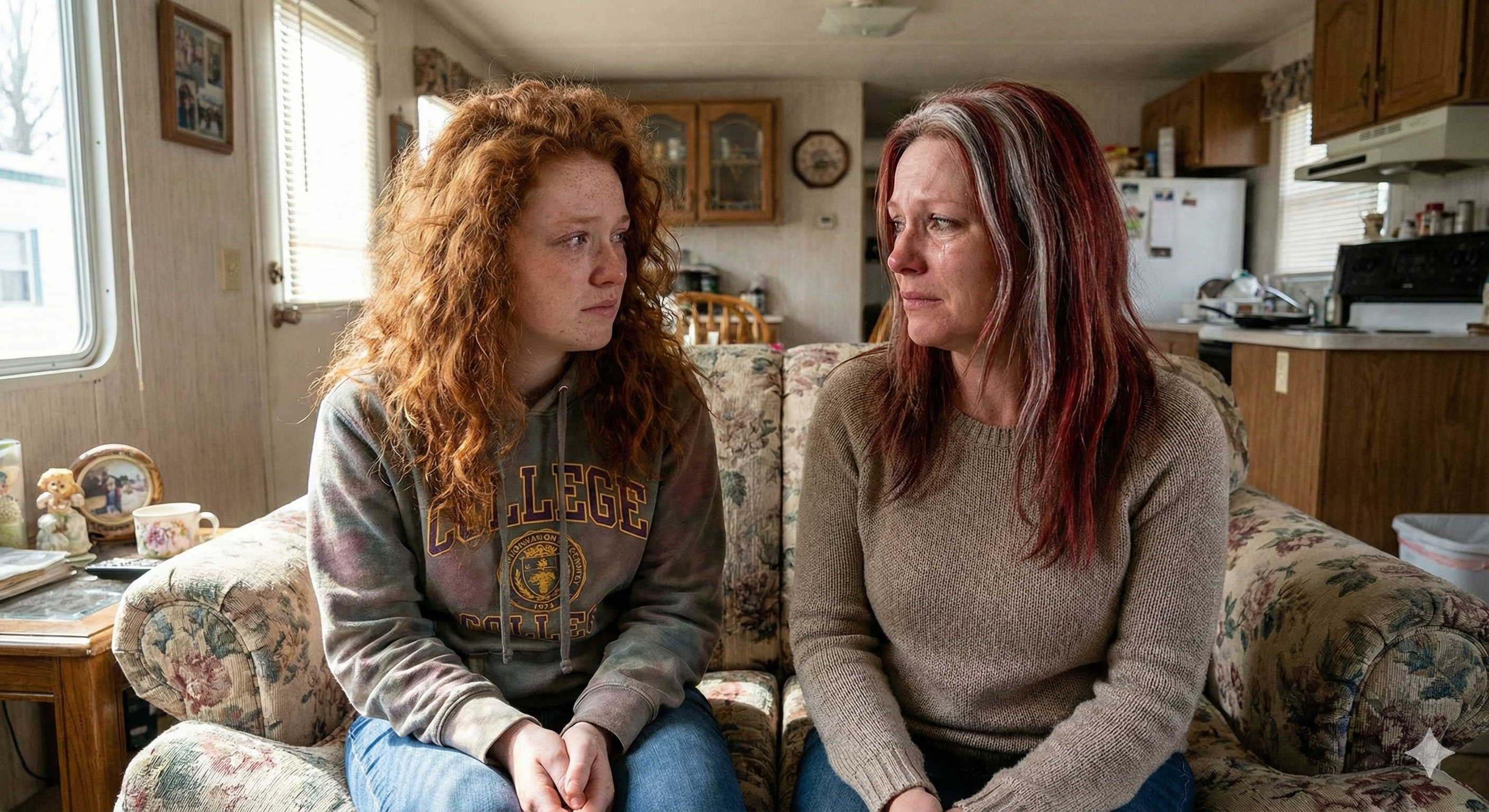
Morning light filters through the small kitchen window of Ji-woo's mobile home, illuminating three young women in various states of wakefulness. Priya stumbles in last, her usually immaculate appearance disheveled—hair uncombed, dark circles under her eyes, moving like someone who hasn't slept properly in days.
Maeve takes one look at her and sets down her coffee mug with a gentle clink.
MAEVE
Priya, do you remember when I said you were insanely gorgeous?
PRIYA
(sitting down heavily) Of course. Why do you ask?
MAEVE
Because this morning you look like crap. Did you sleep at all last night?
Priya lets her head fall into her hands, her long black hair cascading forward like a curtain.
PRIYA
Ugh. I've been having intrusive dreams. Someone is probing me telepathically, and when I'm awake I can block them, but the minute I fall asleep they pop into my dreams and that wakes me up. I need to do some more work so I can filter telepathic messages even when I'm asleep.
JI-WOO
(alarmed) Oh my God. Is it those submarine guys? Are they molesting you in your sleep?
PRIYA
No. I've got them blocked. Whoever is targeting me is way more powerful than those fools are. I think she might not be human.
MAEVE
She? How do you know it's female?
PRIYA
I'm not totally sure, but it feels like a female energy. Persistent. Curious. Not hostile, exactly, but relentless.
JI-WOO
Maybe you should consult the other psychics in the 37 and get some help.
PRIYA
(sighing) I already did. They're no help. I'm already stronger than they are when it comes to telepathy. Most of them can barely send thoughts, let alone defend against intrusion.
MAEVE
How about that remote viewer lady—Mabel? She had you totally blocked in Dallas, remember? Maybe she can teach you her shielding technique.
Priya looks up, hope flickering across her exhausted face.
PRIYA
I didn't think of that. I'll contact her and see if she can help.
Ji-woo begins pulling ingredients from the refrigerator—eggs, bacon, potatoes—and the three work together to make breakfast with the comfortable efficiency of people who've shared many meals. Priya gathers a plate of cooked potatoes and immediately places them in the freezer.
MAEVE
(laughing) Priya, you really are half asleep. You just put your potatoes in the freezer.
PRIYA
(smiling despite her exhaustion) I did that deliberately. When you cook potatoes the starch sort of melts and the glycemic index goes way up. When you cool them the glycemic index goes back down, so you don't get an insulin spike. Gotta protect my insanely gorgeous figure, you know.
PRIYA
No. My blood sugar is fine, and I want to keep it that way.
JI-WOO
Well, glycemic index is only half the battle. You have to control the glycemic load as well. You will still get fat if you overeat.
MAEVE
(groaning) I knew this was going to happen. You guys take a nutrition class and now you're both little know-it-alls. I like my potatoes hot. If I start to get fat I'll run a few extra miles every day.
They eat breakfast together, the conversation flowing easily despite Priya's exhaustion. Then they walk to class—it's not far, and the morning is pleasant enough that they don't mind the exercise.
⬥ ⬥ ⬥ LUNCHTIME ⬥ ⬥ ⬥
Around midday, Priya's phone buzzes with a text message. She glances at it during a break between classes and her eyebrows rise in surprise.
MABEL: Meet me at the pizza place, the one you always go to. There are a few tricks I can teach you.
Priya shows the message to Maeve and Ji-woo. They exchange glances—Mabel is hundreds of miles away in her home city. How does she know about their regular pizza spot? Then again, she's a remote viewer. Of course she knows.
Twenty minutes later, Priya slides into a booth at Angelo's Pizza across from the elderly woman who'd helped them find the missing children. Mabel looks exactly as Priya remembers—silver hair in a ponytail, sharp eyes, practical clothing, and that impenetrable psychic shield that makes her mind a blank wall.
MABEL
(smiling warmly) Thanks for meeting me on short notice. I was in the area visiting my daughter, and I felt your distress telepathically. Thought I could help.
PRIYA
You felt my distress from however many miles away?
MABEL
You're a very powerful broadcaster when you're upset, dear. It's like a beacon. Now, tell me what's happening.
Priya explains the intrusive dreams, the relentless probing, the exhaustion from being woken repeatedly every night.
MABEL
I see. What you need is a technique I learned fifty years ago from a Tibetan meditation teacher. It's a way to set an intention before falling asleep that maintains your shields even when your conscious mind is offline. Let me show you.
Over pizza and sodas, Mabel teaches Priya a short meditation protocol—a series of mental exercises and visualizations to perform in the moments before sleep. The technique involves imagining her psychic shields as a self-sustaining structure that doesn't require conscious maintenance.
MABEL
Think of it like setting a security system before you leave the house. You don't have to stay awake to keep the alarm active—you just set it, and it runs on its own. Your shields can work the same way.
PRIYA
(hopeful) And this will keep the intruders out of my dreams?
MABEL
It should reduce the intrusions significantly. If someone does get through, you'll be able to banish them from your dream space without fully waking up. I've used this technique for decades. It works.
They finish their lunch, and Mabel gives Priya a gentle hug before leaving.
MABEL
Get some rest tonight, dear. And if you need more help, don't hesitate to call me. Us psychics have to look out for each other.
Returning to class after lunch, Maeve catches up with Priya in the hallway.
MAEVE
How did it go? Did she help you?
PRIYA
Maybe. She showed me how she does a short meditation before going to sleep. She says I can set an intention before falling asleep that can block interference and allow me to get some rest.
JI-WOO
I've heard of that. People do that to have lucid dreams, where you know you're dreaming and can control what happens in your dream.
PRIYA
Exactly. If I can become lucid while dreaming, I can actively defend myself against intrusions instead of just passively blocking. I'm going to try it tonight.
After school, Maeve and Ji-woo do homework and watch movies. Priya, totally sleep-deprived, goes to bed early—around eight p.m.—practicing the method Mabel taught her.
⬥ ⬥ ⬥ NEXT MORNING: MARCH 3 ⬥ ⬥ ⬥
Ji-woo is curious whether Priya got any sleep. When Priya stumbles into the kitchen, there's the normal "I just woke up" grogginess, but not the hollow-eyed exhaustion of the previous morning.
PRIYA
(pouring coffee with a satisfied smile) I slept well. The intruders still got into my dreams, but I was aware of it happening. I would take a Star Trek-like phaser weapon and banish them from my dreams so they couldn't wake me up and I could continue sleeping. It was actually kind of fun.
MAEVE
You were lucid dreaming and shooting telepathic intruders with imaginary phasers?
PRIYA
Yep. Set phasers to stun. They'd try to probe me, I'd zap them, and they'd fade away. Worked like a charm. I feel amazing.
JI-WOO
That's the most Priya solution to a problem I've ever heard. Fighting psychic intrusion with sci-fi weapons in your dreams.
The days pass peacefully. Priya continues to sleep well, her dream-phaser technique proving effective. Classes resume their normal rhythm. Life returns to the mundane routine of college—lectures, homework, meals with friends, occasional movie nights.
⬥ ⬥ ⬥ ONE WEEK LATER: MARCH 10 ⬥ ⬥ ⬥
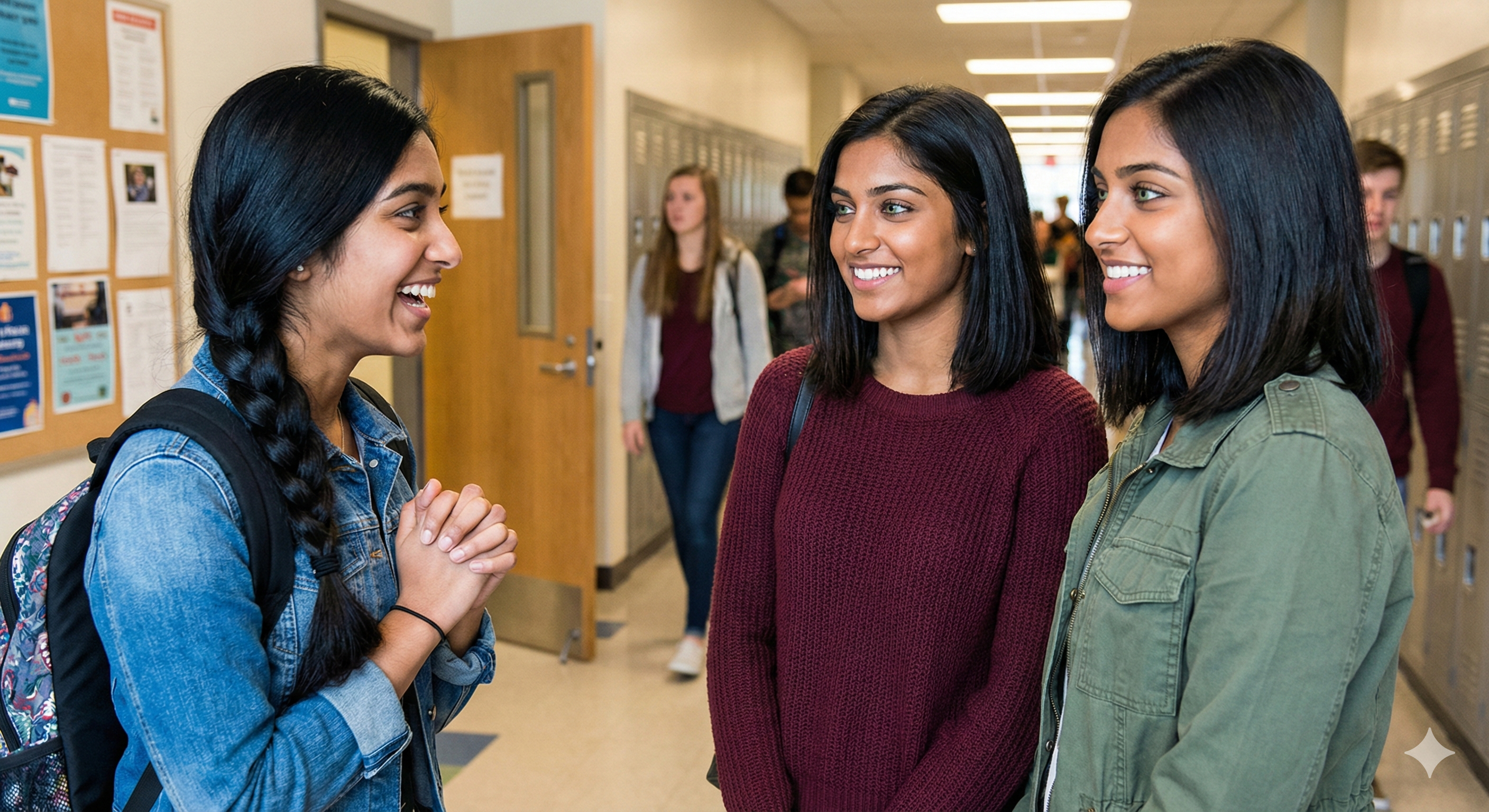
Priya is walking down the main hallway toward the cafeteria when her spatial awareness pings—something Ji-woo's ability has started rubbing off on her, a side effect of their deep psychic connection. Two young women are leaning against the lockers ahead, and as Priya approaches, they step directly into her path.
They're both Indian in appearance, with warm brown skin and dark eyes. They're dressed casually but well—designer jeans, nice jackets, an air of confidence that speaks of resources and purpose. And they're staring at Priya with unsettling intensity.
Priya freezes, her telepathy immediately reaching out to scan their intentions. What she encounters makes her gasp—one of them is completely open, readable as a book. The other is... strange. Otherworldly. Her mental signature doesn't feel entirely human.
PRIYA
(defensive) What do you bitches want? You're in my way.
The more readable one—the fully human one—smiles warmly, completely unfazed by Priya's hostility.
ELLA PATEL
Oh, Priya. We just want to get to know you. We've been tracking you for weeks. Don't worry, it isn't anything bad. We do some work for the Navy from time to time and the Commander wanted us to come see you. We're psychic, telepathic like you, and he wanted us to get to know you.
PRIYA
Navy? Did you say Navy? I work for the Navy from time to time too. I would suspect you would already know all about me.
ELLA
Hi. My name is Ella Patel and this is my sister Helana Danvers. The Navy has dozens, maybe hundreds of little secret programs and they're all compartmentalized, so they don't share information. You showed up on our radar about a month ago when there was an atemporal breach and a psychic was involved. I guess that psychic was you.
PRIYA
Oh. Yeah. That thing. It's supposed to be secret. There were actually thirty-seven of us, but I'm the most psychic when it comes to telepathy anyway. And I'm getting stronger all the time.
The other woman—Helana—laughs, and the sound has an almost musical quality that reinforces Priya's sense that she's not dealing with a normal human.
HELANA DANVERS
Yeah, we noticed. At first we could read you a little bit, but then you started shooting at us. So we had to come see you in person. Let's get to know each other. I think we have a lot in common. Let's get together this evening for dinner or something.
Priya thinks for a minute, then deliberately drops her defensive shields and probes them both more deeply. Ella and Helana, sensing her intention, drop their own blocks and allow Priya to read them fully.
Scanning... Ella: fully human, telepathic abilities, genuine curiosity, no hostile intent, works with Navy on classified projects... Helana: NOT HUMAN. Or not entirely human. Energy signature like nothing I've encountered before. Ancient. Powerful. But also... kind? Curious? She's the one who's been probing my dreams. Not malicious—just trying to understand me. They're telling the truth. They want to meet. They want to be friends.
PRIYA
Okay. You guys look legit. Meet me at my house after school. I'm sure you already know where that is.
ELLA
(grinning) We do. See you at five?
Priya has prepared for the visit—ordering pizza, wings, and soda to be delivered just before five. When Ella and Helana arrive, Maeve and Ji-woo are already there, curiosity and caution balanced in their expressions.
Ji-woo opens the door and immediately does a double-take.
JI-WOO
OMG, you're identical triplets!
PRIYA
They're twins, but I don't look like them.
JI-WOO
(laughing) You Indian people all look the same to me.
MAEVE
(stepping forward, her copper hair catching the light, her tone polite but firm) So, you girls, why are you here? What do you want from us?
ELLA
(laughing at Maeve's directness) Glad to meet you too. Two reasons, really. One is that there's a fellow telepath our age, working on secret Navy projects like us, and we want to get to know you since we seem to have so much in common. We're even the same age. You're about to turn twenty and we just turned twenty. The other reason is that we want to recruit you for our project—not today, but soon in the future. We need all the help we can get.
Priya guides everyone to the living room where the food is spread out. They settle onto the couch and chairs, and for a moment there's the comfortable chaos of distributing pizza slices and napkins.
PRIYA
Before we talk about secret projects, tell me about you. How did two Indian girls get mixed up with the Navy? The Navy created us through genetic manipulation and surrogate mothers. Did they make you too?
Helana's expression shifts—something ancient and sad flickering across her young face.
HELANA
Oh my. We didn't know that you were engineered. That makes me sad. No, Ella and two of her friends were having a sleepover when they were thirteen, and I decided to come visit them. At the time I was an interdimensional traveler, a little Tinkerbell-size girl who came to visit Ella and her friends because in my time, five hundred million years in your future, they were part of our history. They were famous, and I wanted to meet them.
HELANA
We became friends and I did what I was forbidden to do—I stayed too long. I was just supposed to stay for a minute and not be seen, but they saw me and I sort of got trapped here. I was going to go back to my time but I found out I couldn't because I was absorbing the density of this domain and if I went back I would explode, so I had to stay.
HELANA
That's where the Navy came in. They had equipment they'd gotten from UFOs that allowed them to let the density of this domain grow me up to full size without killing me, and here I am. Part of my DNA fused with Ella's DNA during the process and that's why we're identical, although our DNA was already pretty close.
Priya stares at Helana, trying to process what she's hearing. Her telepathy confirms it's the truth—or at least, Helana believes it's the truth.
PRIYA
I suppose that's why your energy that I sense is so different from Ella's, but it's going to take some time to wrap my head around your story. So what is this project that you need help with?
ELLA
It's complicated. But Helana, having come from the future, their history says that in about thirty years there will be a confluence of things—cultural collapse, a solar micro-nova, global nuclear war, all at the same time resulting in an extinction level event. The Navy has come to the same conclusion, that we are on the brink of human annihilation.
ELLA
Helana's history also says that me, Ella, and my friends were instrumental in saving five percent of the human population, and specifically human technology, so that humans could rebound to over one billion people again by the 2100s. So we are now studying where we can build safe places for humans to survive the coming catastrophe—underground, in mountain caverns, in shelters, et cetera. We also need to find ways to preserve technology, sort of like a seed bank for computers, so that we don't have to start over like cave men.
ELLA
But we need all the help we can get to save even the five percent, otherwise humanity will go extinct. You won't need to do anything right now—we're too young. But we want you read into the project, and as time goes by to become influencers to help get more people, especially young people, to help save our species.
JI-WOO
So what is Earth like five hundred million years in the future?
HELANA
Well, it's different. I didn't actually live on Earth. We transitioned to a different domain eons before. Earth humans continued to evolve and left the planet as it was becoming less habitable. You wouldn't recognize them as human anymore. They look more like what you would call an ET.
HELANA
In our more ethereal domain our DNA was more stable, less need to adapt to changes, so I still look human, like you. The Sun kept getting hotter causing the Earth to get hotter. It causes a thing called CO2 starvation and there is too little CO2 for the plants and they die out. There is still some plant life there and there are still some animals there, but the humans all left and went other places.
HELANA
But for you that is all in the distant future and your timeline may not be exactly what my people remember. After so many millions of years our memory of Earth is as much myth as reality. My coming here and getting stuck here also created a temporal anomaly, a change in the timeline that has impacted how the future is playing out. There was a history where I wasn't here and now there is a history where I am here. Those two timelines will eventually merge into one timeline, but the future will be different from how my people remember it.
MAEVE
Well, that's an interesting story of temporal dynamics. Sounds all Star Trek-y. What can we do for you today?
ELLA
We just wanted to meet you, get to know you, and let you know what we are all about. Today is just about getting to know each other. We will keep in touch from time to time, with Priya, if she doesn't block us. I hope we become friends and I hope in the future that we can work together. So we will leave now and let you get back to your normal lives. Pray that we can save humanity, or even change the timeline to avoid the catastrophe altogether.
Ella and Helana stand, gathering their jackets. There are polite goodbyes, promises to stay in touch, and then they're gone.
As the door closes, Maeve rushes to the window and peers out.
MAEVE
Did you see what they were driving? Nice! And from the license plate I think it's not a rental. They must be getting paid too. Smart girls.
To read about Ella's Story click here Ella's Story | My Love From The Future
⬥ ⬥ ⬥ AFTER THEIR DEPARTURE ⬥ ⬥ ⬥
After Ella and Helana leave, Priya stands up with sudden purpose, her expression shifting from thoughtful to determined.
PRIYA
Okay, girls. Sit down for a minute. We need to have a meeting, and I'm broadcasting this to the girls of the 37, those that can sense my telepathy. We have a problem.
Maeve and Ji-woo exchange concerned glances and settle onto the couch. They can feel Priya's telepathy expanding outward, touching the minds of their fellow Constellation members across the city and beyond.
PRIYA
I keep tabs on the Navy. I can't always hear their thoughts or words, but I can sense their intentions. They are worried that by activating us at this time they have created a weapon they cannot control—their worst fear. They are planning on how to create the next generation of psychics, military assets that they can use for their purposes. Children that they will own and control.
PRIYA
Those children are our babies, and we can't allow that to happen. Our recent trip to Hawaii was very expensive, but they had an agenda they aren't talking about. They are also planning a huge birthday party for the 37 somewhere that will also be very expensive. They are not doing this because they love us.
PRIYA
They are hoping that by creating these social events, the girls and boys of the 37 will hook up and make babies that will inherit our abilities. They even have plans to guide certain couples to be together so they can optimize the inherited abilities. They are planning to breed us like cattle.
Maeve's face flushes with anger, her green eyes blazing. Ji-woo's expression goes cold and hard.
PRIYA
Now if a few of us do hook up with other members of the 37, that's fine, if it's organic and not manipulated. As an Indian I'm sensitive about arranged marriages that my ancestors have suffered through for hundreds of years. It isn't going to happen here. I'm going to write a letter to the Navy and let them know that their plan isn't going to work.
PRIYA
Us girls of the 37 will date whoever we want, when it is the right time, and for me the last thing I need right now is a boyfriend, or a baby. I hope all of you, the girls of the 37, will support me and stand up for me when I let the Navy know their evil plan is dead on arrival.
Priya, Maeve, and Ji-woo join hands, forming their familiar triangle of power.
MAEVE
We support you, Priya. The most important decision any of us girls will ever make is choosing the father of our children. We will do that without any help from the Navy. I do hope they don't cancel the birthday party though.
JI-WOO
Agreed. Our bodies, our choices. Our lives, our decisions. They created us, but they don't own us.
Across the city and across the country, the female members of Constellation receive Priya's message. One by one, they send back their agreement. Solidarity. Resistance. The determination to control their own destinies.
◈ BOUNDARIES ESTABLISHED ◈
PRIYA'S DISCOVERY: The Navy plans to manipulate Constellation members into breeding the next generation of psychic assets
THE RESPONSE: Unanimous rejection by all female members of the 37
THE DECLARATION: We will choose our own partners, our own futures, our own lives
THE STAND: We are not cattle. We are not breeding stock. We are people with agency and rights.
ALLIES DISCOVERED: Ella and Helana—two psychics working on humanity's survival
MYSTERY REVEALED: Helana is from 500 million years in the future, trapped in our time
WARNING DELIVERED: Extinction event predicted in approximately 30 years
MISSION ACCEPTED: Help save 5% of humanity when the time comes